

I was born a space nerd. From my earliest times, I remember joining my dad on the couch each week with a bowl of popcorn to watch Doctor Who. From there, Dad introduced me to Star Trek, and I was hooked, never to look back. As a very young girl, I stood on our front lawn beside my father when science fiction met reality as astronauts set foot on the moon.
Since that time, I’ve hoped for and dreamed of the time when we humans would take the leap to travel past the moon to Mars and beyond. When I set out to create the universe for my upcoming Rift Riders series, I poured those dreams into the story, hoping to capture that pivotal moment in human history, that threshold between being stuck in our own solar system and reaching for the stars.
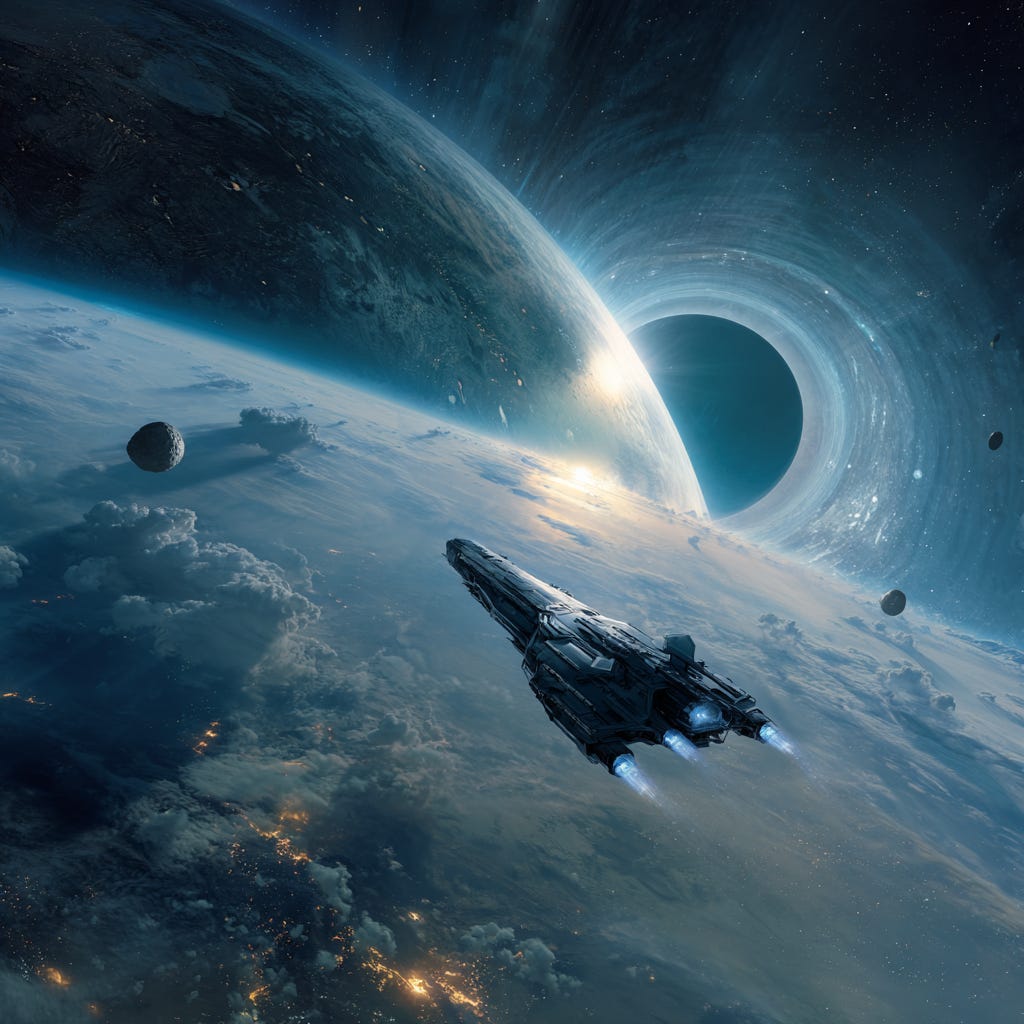
In the first book in the series, Cosmic Chasm, Earth stands at the cusp of the twenty-fifth century as a civilization that has mastered interplanetary travel but not interstellar flight. Humanity has spread across our solar system, establishing outposts and colonies on Mars, the moons of Jupiter and Saturn, and mining stations throughout the asteroid belt. We’ve become comfortable in our neighborhood, but the vast gulfs between star systems remain insurmountable barriers. Until now.
This technological limitation shapes everything about the world my characters inhabit. Space travel is routine but constrained. Trade happens between planets, not galaxies. Scientific advancement has continued for centuries, yet faster-than-light travel has remained frustratingly out of reach despite countless theories and failed experiments.
That all changes when revolutionary physicist Quarin Mannin finally discovers how to create stable spatial rifts that could theoretically punch through the fabric of space-time itself. The discovery represents the most significant leap forward in human capability since the first rockets left Earth’s atmosphere. But this discovery is so monumental, so potentially dangerous, that it becomes the most carefully guarded secret in human history. The world knows something is coming, but only a select few understand what’s truly at stake.
The secrecy surrounding rift technology creates a world of tension and intrigue. While humanity has colonized the solar system, the question of governance and control has become increasingly complex. Who decides when humanity is ready to leap to the stars? What happens when a discovery this powerful falls into the wrong hands? In building this universe, I wanted to explore how the promise of unlimited expansion might corrupt those who seek to control it. The space agencies and corporations of the twenty-fifth century aren’t so different from today’s power structures. They’re just playing for infinitely higher stakes.
What excites me most about this setting is its potential. By placing humanity right at this threshold moment, I get to explore both the wonder of first contact with the greater universe and the very human dangers of ambition and sabotage. When my protagonist Remy Ashmore and her crew are catastrophically thrown across space to a distant galaxy, they’re not just fighting to survive, they’re the first humans to truly become interstellar, whether they’re ready or not. They’ll encounter possibilities and dangers that Earth-bound humanity hasn’t even imagined yet. And back home, the battle over who controls humanity’s future among the stars is just beginning.
I’m excited to bring this interstellar series to you starting early in 2026. Until then, do you believe interstellar travel will ever be possible? If so, how? Let me know by clicking the comment button below!
As always, happy reading!


Yes, given enough time, mankind will definitely find a way to reach the stars. I wish it would happen sooner rather than later so I would be around to see it. But I am hopeful I'll at least see us set foot on Mars, as NASA already has a plan to make that happen soon.
Your Cosmic Chasm series sounds very exciting. Stories about space exploration are always some of my favorites. Can't wait to read yours. I enjoyed reading your book Solar Fury several years ago and enjoyed it very much. I did not read the rest of the series because back then I read too many books on the end of civilization through similar events and I got burned out on the genre. So, I'm excited to see you turning gaze toward the stars. That's a frontier that still has a lot to be explored.
I think it's very possible, if we can somehow push human nature out of the way of scientific progress. Greed, narcissism, and psychopathic heads of industry pose challenges to any endeavor that will require collaboration with multiple nations to manage the expense.
Or perhaps religious zealots will blow up the research facility before it can successfully replicate its findings and gather the support and resources needed to execute on the technological paradigm shift this represents.
It's possible. We just need to allow the true pioneers to follow through with their dreams. Support science, from elementary school and beyond. Be our better selves and protect the dreamers who make the formerly impossible things possible.